

Humankind’s fascination with diamonds is as old as civilisation itself, but throughout history there have been some particularly remarkable stones that continue to captivate the collective imagination. Be it unprecedented size, provenance, or notorious owners, read on for a roundup of five of the most legendary diamonds that stir the soul to this day.
1. The Hope Diamond
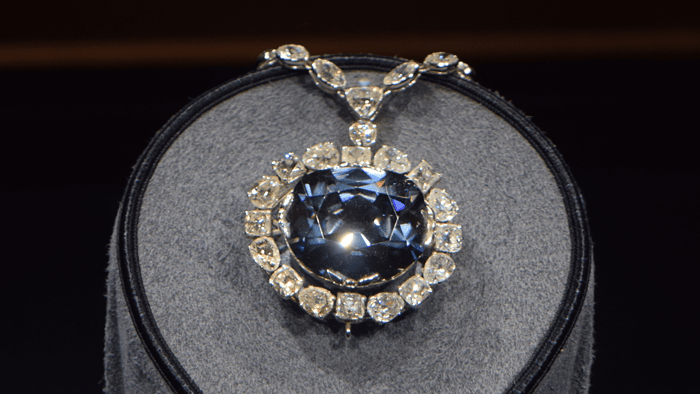
A deep blue diamond weighing 45.52 carats (making it the fourth largest blue diamond in the world), the Hope Diamond is famous for its striking colour and…its reputed curse.
Originally acquired as an uncut stone by French merchant Jean-Baptiste Tavernier from the Kollur mine in Golconda, India, it has a chequered history, and is said to bring bad luck to all who possess it. Once the eye of a Hindu statue in a holy temple, it was allegedly stolen and sold to the French aristocracy. King Louis XVI and Marie Antoinette are amongst two of the diamond’s ‘victims’, both beheaded whilst it was in their ownership. The diamond was again stolen during the French Revolution and later re-cut by Dutch jeweller Wilhelm Fals, who was then brutally murdered by his son who took the diamond for himself. The stone’s curse drove its new owner to madness, culminating in him taking his own life. The ill-fated diamond disappeared from the history books, before reemerging years later in England, which is where it acquired its Hope moniker – named after the British banking family who owned it.
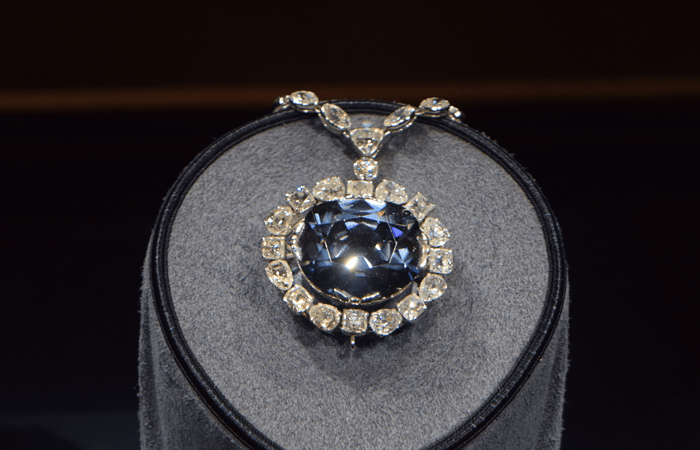
The stunning Hope Diamond weighs an incredible 45.52 carats.
Said to be the inspiration for the Heart of the Ocean in James Cameron’s Titanic, the diamond now resides at the Smithsonian Institution in Washington, D.C, where it was donated by Harry Winston in the ‘50s. The act of donation (rather than a sale) is said to have broken the stone’s curse.
2. Koh-i-Noor
This diamond, whose name means ‘Mountain of Light’, is an astonishing 105.6-carat gem with a rich history dating back over 5,000 years. Originating from India, the Koh-i-noor was acquired by the British in 1849 during the annexation of the Punjab and placed among the crown jewels of Queen Victoria.
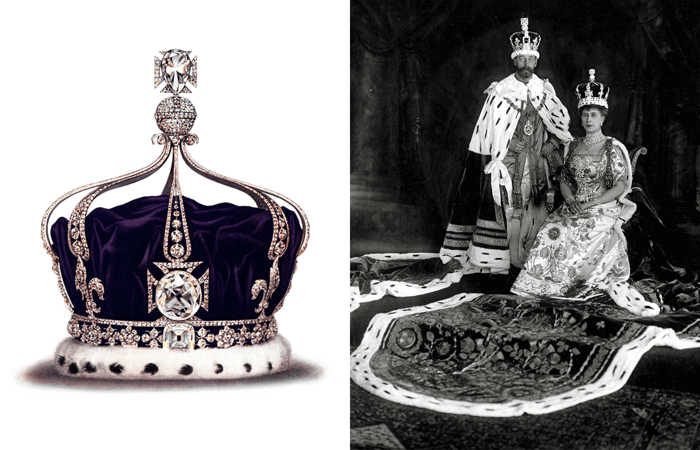
The Koh-i-noor can be found as part of the British Crown Jewels collection.
Originally weighing 191 carats, the diamond was met with an underwhelming response when presented to the British public and as such was recut in 1852 by royal jeweller Garrad to enhance its fire and brilliance, a process which almost halved its size.
Many view the Koh-i-Noor as a problematic symbol of colonial conquest. The British monarchy has limited its usage — it was notable by its absence at the recent coronation of King Charles III.
3. Black Orlov
Also known as the ‘Eye of Brahma’, this 67.5-carat black diamond has an intriguing history filled with legends and tales of misfortune. It is believed to have originated (or was possibly stolen) from an Indian temple and has been associated with both beauty and mystery.
The Black Orlov diamond is also known as the ‘Eye of Brahma’.
In 1932, diamond dealer J. W. Paris reportedly took the diamond to the United States, and soon after committed suicide by jumping from a skyscraper in New York City. Later owners of the diamond included two Russian princesses, Leonila Galitsine-Bariatinsky and Nadia Vygin-Orlov (after whom the diamond is named). Both women allegedly jumped to their deaths in the 1940s. The diamond was later bought by Charles F. Winson, and cut into three pieces in an attempt to break the curse; the 67.5-carat Black Orlov was set into a brooch of 108 diamonds, suspended from a necklace of 124 diamonds.
4. Taylor-Burton Diamond
This pear-shaped diamond weighing 69.42 carats was originally known as the Cartier diamond but soared in notoriety when it was purchased by actor Richard Burton for his then-wife Elizabeth Taylor back in 1969.
The Taylor-Burton diamond is a 69.42-carat pear-shaped diamond, originally known as the Cartier Diamond.
Cut from a larger 240.80 carat stone found in South Africa’s Premier Mine, the stone was purchased at auction by Burton for $1.05 million, becoming an instant symbol of romantic decadence in diamonds. The stone was sold by Taylor in 1979 for $3 million but remains iconic in pop culture to this day.
5. The Sancy Diamond
A pale yellow diamond of 55.23 carats, the unusually cut Sancy diamond was rumoured to both carry a curse and bestow powers of invincibility to those who wore it. Named after its 17th-century owner, Nicolas de Harlay, Seigneur de Sancy, the diamond was pawned multiple times. During a fateful transfer to King James I, Sancy's servant swallowed the gem to protect it from robbers but was ultimately killed, with the diamond later recovered from his stomach.
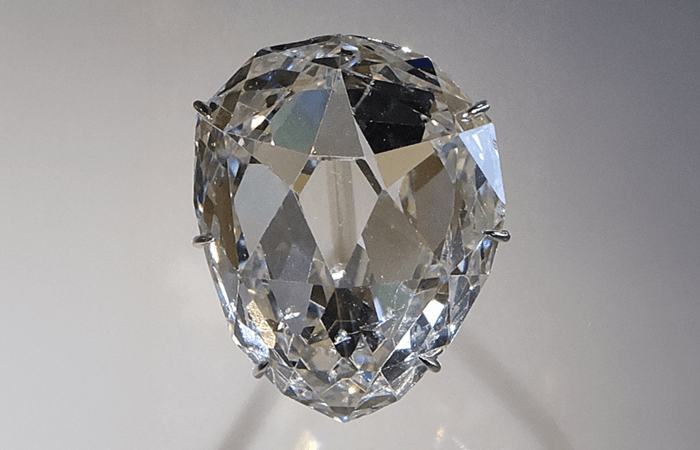
The Sancy Diamond can be viewed at the Department of Decorative Arts of the Louvre.
Today, the Sancy diamond can be viewed in the Apollo Gallery in the Louvre, where it continues to captivate and delight visitors from around the world.