
‘Because you’re not like anyone else.’ With those words, Mr. Big presents Carrie Bradshaw with a black diamond engagement ring in the final scene of Sex and the City 2. That moment wasn’t just a clever script choice, it marked a cultural shift in how black diamonds are perceived: no longer a rarity kept to the fringes of fine jewellery, but a bold, meaningful alternative to traditional white stones.
Once overlooked and misunderstood, these precious black gems are now commanding attention on red carpets, in bespoke collections, and on the fingers of modern brides who value individuality above all. But behind their dark facets lies a story that stretches back billions of years, and possibly even beyond planet earth.
A Brief History of Black Diamonds
Historically, black diamonds, also known as carbonado, were not held in high esteem. Their opaque appearance and heavily included structure set them apart from the brilliant, colourless diamonds most consumers desired. For years, they were seen as industrial-grade material, used more for drilling than for wearing.
But that same internal structure that once limited their appeal is now the source of their intrigue. Unlike other diamonds, which form deep within the Earth’s mantle and are brought to the surface by volcanic activity, the origin of these dark stones is still uncertain. Most are found in alluvial deposits in Brazil and the Central African Republic, two geographically distant regions that curiously lack any volcanic pipes, adding fuel to the theory that carbonado may have extraterrestrial origins.
In fact, some scientists believe that natural black diamonds may have formed from supernova explosions and landed on Earth via meteorites over 2.6 billion years ago. A dazzling example? The Enigma, a 555.55 carat natural black diamond, the largest of its kind, believed to have cosmic origins. Cut with 55 facets to reflect its symbolic connection to the number five, The Enigma is not only a marvel of geology, but a cultural artefact that underscores just how unique these dark gems truly are.
Why You Should Choose a Black Diamond
Aside from their mysterious past, black diamonds are among the toughest gemstones known to man. With a composition that includes countless microscopic graphite inclusions, carbonado is even harder than conventional diamonds. This durability has made these stones highly valued for industrial use, but it’s their bold, unconventional aesthetic that is redefining them in the world of luxury jewellery.
Today, black diamonds are being embraced as a fashion-forward choice. Celebrities like Jennifer Lawrence have worn black diamond earrings on the red carpet, while bespoke designers are increasingly incorporating them into engagement rings, earrings, and statement necklaces.
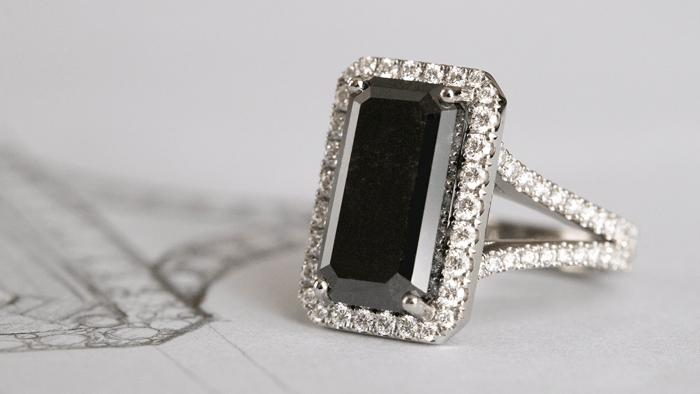
In engagement jewellery, they offer a unique alternative for those who reject tradition. Their deep, velvety colour pairs exquisitely with white diamond accents: be it in trilogy settings, diamond halos, or Toi et Moi designs. Their rarity only adds to their appeal: natural black diamonds are uncommon, and many stones on the market have been heat-treated to enhance their dark tone. These treated stones offer a more accessible price point, though discerning buyers will often seek out natural, untreated specimens for their authenticity and value.
How to Wear Black Diamonds
Thanks to their rich colour and high durability, black diamonds are highly versatile in design. They lend themselves equally well to modern minimalist pieces and vintage-inspired creations.
Depending on the intensity of their colour, they may also reveal subtle reflective flashes, especially when expertly cut and polished. This interplay of light gives them a mesmerising depth, making them particularly striking when set against bright white diamonds or coloured gemstones.
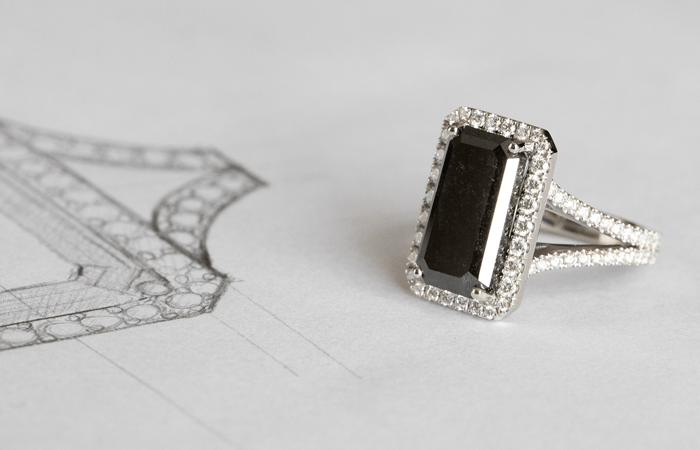
77 Bespoke ring created for Myleene Klass
At 77 Diamonds, we’ve seen an uptick in demand for bespoke black diamond pieces. Our clients often opt to pair them with white diamond halos or in asymmetrical designs that highlight their contrast and depth. A recent standout is the bespoke engagement ring created for Myleene Klass by our Head of Bespoke, Anna Byers: a striking black diamond centre stone surrounded by a vivid white diamond halo, showcasing the stone’s intensity.
Creating such an iconic ring which also served to highlight the beauty of more unconventional diamonds was a real privilege.— Anna Byers, Head of BespokeWhether you're looking for a classic solitaire or a daring double-stone setting, black diamonds offer endless potential for design innovation. What's certain is that our bespoke team is always ready to help bring those visions to life through a unique collaborative process between designer and client.
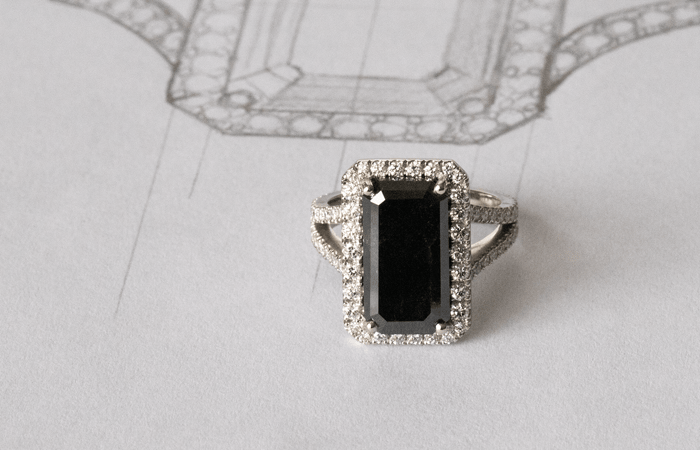
77 Bespoke ring created for Myleene Klass
What to Remember About Black Diamond Quality
Buying a black diamond isn’t quite the same as purchasing a traditional white stone. That’s because black diamonds fall outside the standard 4Cs grading system used for colourless diamonds. The GIA does not grade black diamonds for clarity or cut in the same way, it focuses instead on characteristics like colour intensity and whether the stone has been treated to achieve its hue.
Most black diamonds available on the market are treated, typically via high-temperature, low-pressure (HTHP) processes that enhance their blackness by increasing the number of internal inclusions. While treated black diamonds can still be beautiful, they are less rare and typically less valuable than natural carbonados.
This makes certification essential. Look for stones that come with a GIA certificate stating their colour origin, natural or treated. At 77 Diamonds, our gemstone experts can also independently assess and certify a black diamond, offering peace of mind and complete transparency when a GIA certificate is unavailable.
We always recommend that customers purchase a black diamond with a certificate from a reputable business or certifying entity, this guarantees peace of mind if you ever want to resell your diamond or pass it on to family members as heirloom jewellery.— Varun Gohil, Lead Diamonds DepartmentWhen purchasing, it’s important to weigh the value of natural rarity against visual appearance and budget. But whether you choose a natural or treated black diamond, ensure it has been responsibly sourced and professionally assessed by gemologists or accredited jewellery experts.