
If you're shopping for diamonds, you've probably heard of the "4 Cs" (cut, colour, clarity, and carat). But these diamond terms are just the tip of the iceberg! Professional gemologists and diamond traders use many other classifications that are considered just as useful for judging a diamond’s beauty, but rarely make it into consumer guides. Intrigued? Read on:
1. Fluorescence
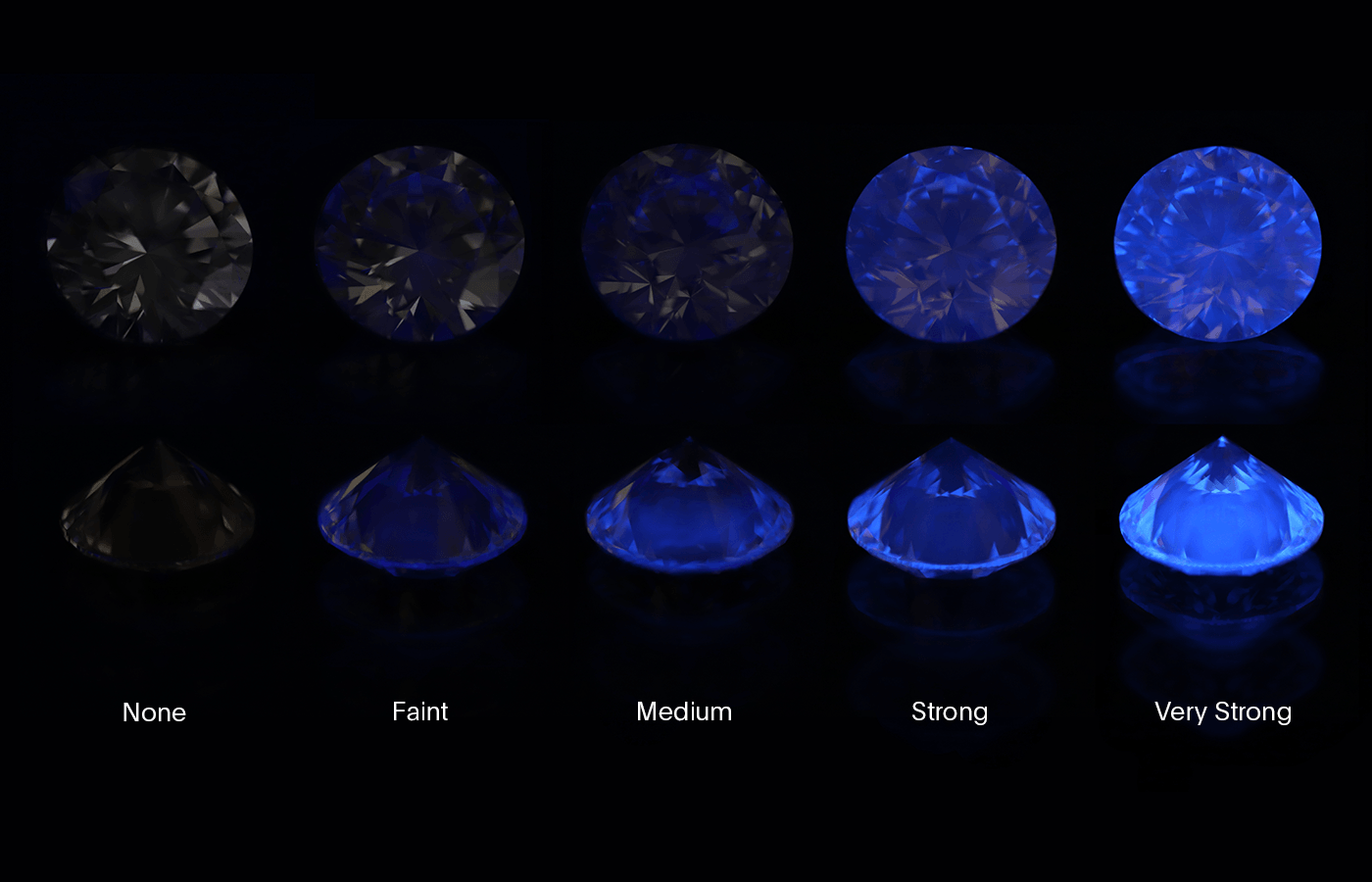
Fluorescence one of those diamond terms that confuse a great many first-time shoppers. This relates to a diamond's tendency to glow under ultraviolet (UV) light. Roughly between 23-25% of diamonds exhibit some fluorescence.
Generally appears blue, though other colours exist.
Usually invisible indoors (unless UV light is present).
Can make some diamonds look whiter in sunlight.
In rare cases, strong fluorescence can give stones an undesirable hazy or oily appearance.
Many buyers think strong fluorescence is automatically a bad thing. In reality:
Most fluorescent diamonds look completely normal to the naked eye.
Some can offer excellent value, because they can be sold at a discount.
Only a small percentage develop the hazy or oily appearance that buyers should avoid.
Gemological laboratories like the Gemological Institute of America (GIA) grade fluorescence on a scale:
None > Faint > Medium > Strong > Very Strong
2. Fire
Fire is the display of spectral colours, or rainbow flashes, that are produced when white light is refracted through a diamond. In simple terms, think of how a prism behaves under direct light. People often confuse diamond terms such as this one with a diamond’s brilliance, but it’s important to note they’re not the same thing: brilliance is white and dark sparkle, and fire is colourful flashes and one of the most magical parts of a diamond’s beauty, although it can’t be seen in every environment.
Also known as dispersion, a diamond's fire is the vivid rainbow flashes created as light passes through it.
Red, blue, green, yellow, and other colours appear to flash from the diamond.
Most visible under direct spot lighting, such as jewellery showroom lighting or direct sunlight.
The production of fiery diamonds depends heavily on cut quality and facet proportions.
3. Light Leakage
This refers to light escaping through the bottom (the pavilion) or sides (the girdle) of a diamond instead of returning to the viewer's eye. Generally, the greater the leakage - the less sparkle, and the dully or more glassy a diamond appears. The culprit? Generally, it’s poor proportions. If the bottom half of the diamond has been cut too shallow, or too deep, light can’t properly reflect upwards.
More leakage generally means less sparkle.
Two diamonds with identical carat weight and clarity may perform very differently because of light leakage.
Specialised imaging tools can reveal areas where light is being lost.
Light leakage occurs when the facets on a diamond are angled in a way that allows light to pass through, rather than reflect back up.
Many experts consider light performance more important than some traditional grading factors. Two diamonds with identical carat weight and clarity may perform very differently because of light leakage.
How to tell if light leakage is going to be an issue? Specialised imaging tools known as an ASET (Angular Spectrum Evaluation Tool) can reveal areas where light is being lost.
4. Milkiness
A diamond can appear cloudy or ‘milky’ rather than crisp and transparent when internal flaws scatter light, rather than transmitting it clearly. This could also be referred to as haziness or cloudiness.
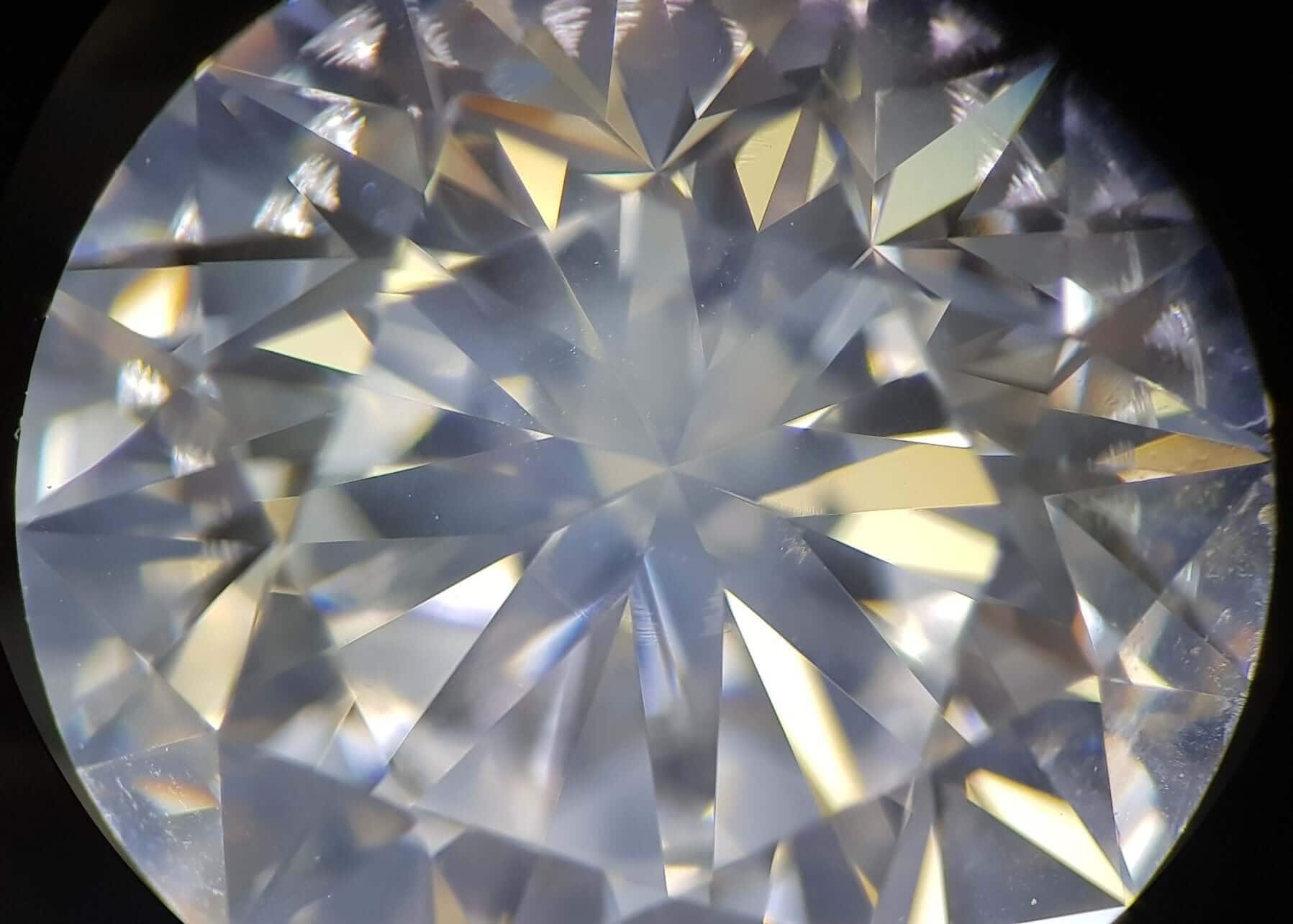 A milky diamond appears cloudy, rather than clear and clean.
Most likely to be caused by dense clusters of microscopic inclusions (often called ‘clouds’)
In some natural diamonds, milkiness can sometimes be linked to strong fluorescence.
Can significantly reduce sparkle, even if the clarity grade looks good on paper.
Two diamonds with the exact same clarity grade can look dramatically different because of milkiness.
5. Bow-Tie Effect
One of those diamond terms you might come across, but that is rarely explained. The bow-tie effect is a natural optical phenomenon that’s common in oval, pear, and marquise-shaped diamonds. It’s caused when the light entering an elongated diamond cut fails to reflect back to the viewer’s eye, creating an illusion of darkness.
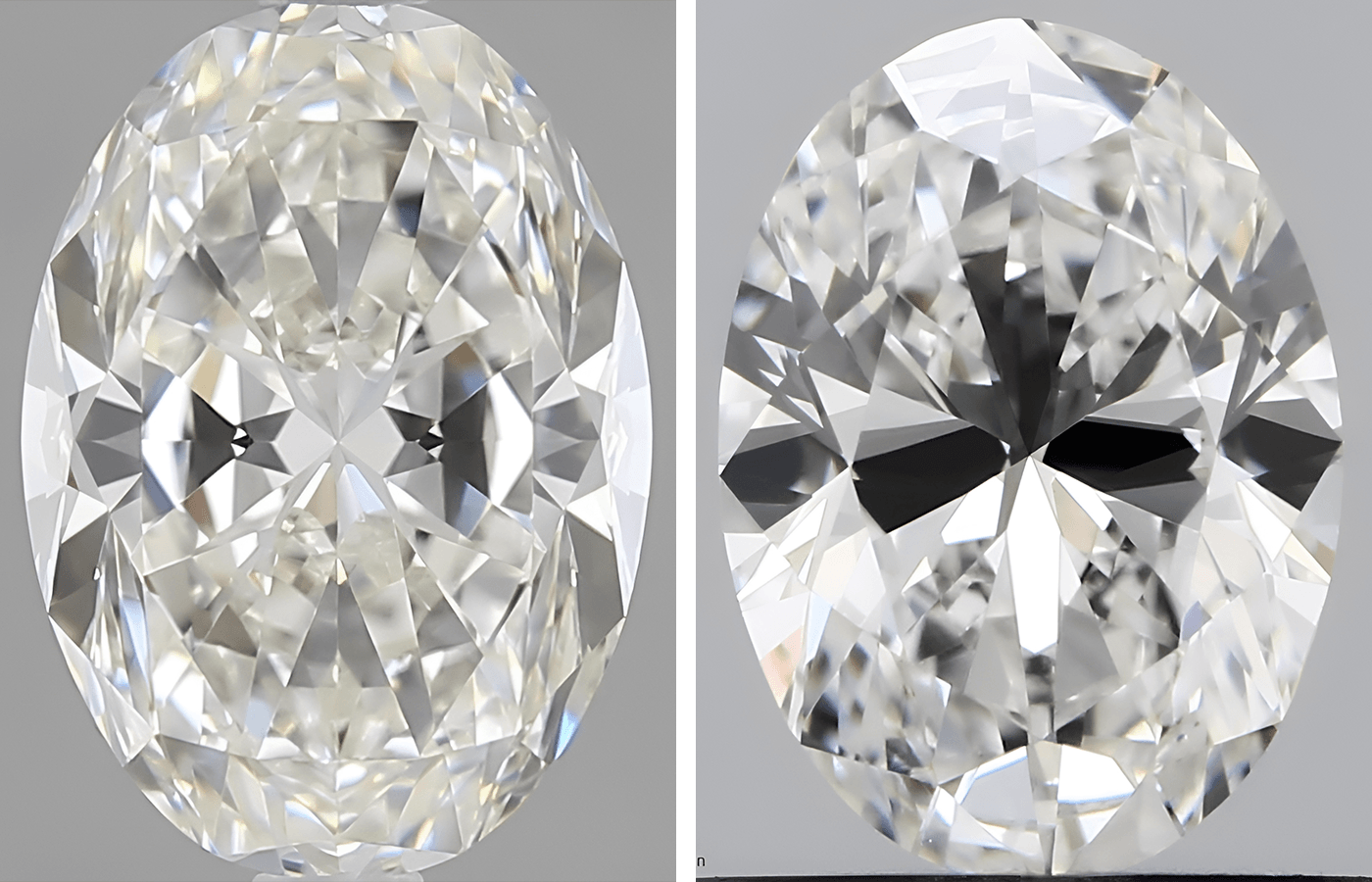 Left: Light bow-tie; Right: Heavy bow-tie
Appears as a dark bow-tie-shaped shadow across the center of the stone.
Caused by the way light reflects inside the diamond.
A mild bow tie is normal in elongated shapes, but a strong one can reduce brilliance.
A note from 77
At 77 Diamonds, we offer a wide range of stones that meet our rigorous quality standards. No diamonds are available that have been graded lower than an L colour, we don’t offer any ‘included’ diamonds, and the lowest clarity grading we offer is slightly included. Similarly, the lowest cut quality we offer is ‘good’ .